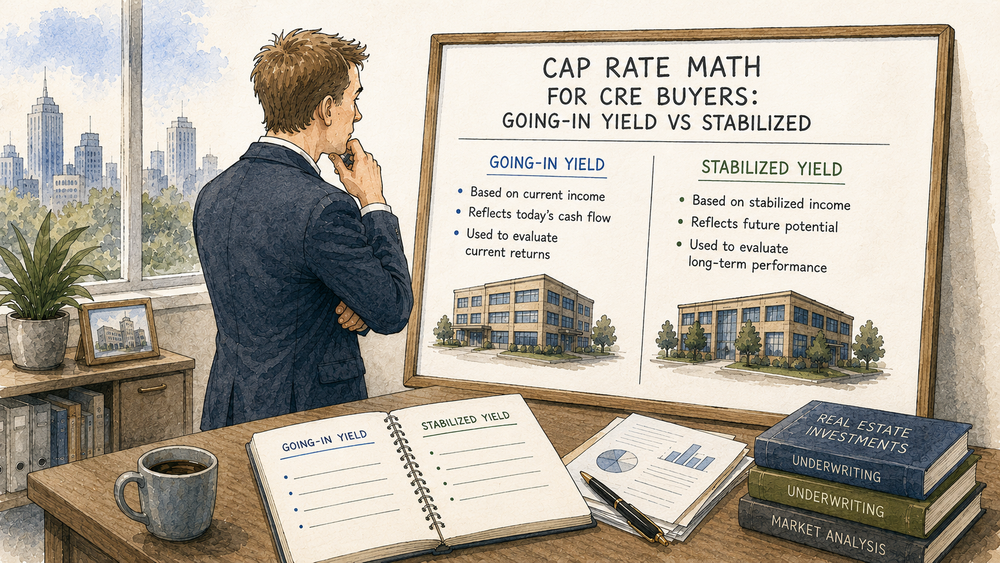
Cap rate is the single most-used — and most-abused — number in commercial real estate investment. Every buyer, every listing broker, every lender uses it. Few use it the same way. Understanding the difference between a going-in yield and a stabilized cap rate isn't a nuance. It's the difference between underwriting a deal correctly and overpaying by 15%.
What a Cap Rate Actually Is
Cap rate (capitalization rate) is Net Operating Income divided by Purchase Price. That's the whole formula:
Cap Rate = NOI ÷ Price
It tells you the unleveraged yield on a property — what you'd earn annually as a percentage of what you paid, before debt service, before depreciation, before taxes. A $2,000,000 property generating $120,000 in NOI is a 6.0 cap. Clean concept. The mess comes from which NOI you're using.
There are three distinct NOI figures that show up in deal analysis, and brokers don't always label which one they're quoting:
- Trailing 12-month NOI — actual income and expenses over the past year, as-is
- Going-in (Year 1) NOI — projected NOI for the first full year of your ownership, based on in-place leases and current expenses
- Stabilized NOI — projected NOI once the property reaches a normalized occupancy and rent level, which may be one to three years out
When a broker quotes a cap rate on a value-add or lease-up play without specifying which NOI, assume they're quoting the most favorable number available. Your job as the buyer is to know which version you're looking at and price the deal on the one that actually reflects your risk.
Going-In Cap Rate: The Starting Point
The going-in cap rate — also called the going-in yield — is what the property will actually produce for you on Day 1 of ownership, based on in-place leases and current operating expenses. No credit is given for vacant space, below-market leases, or anticipated rent bumps.
Worked Example: Mira Mesa Industrial Flex
Consider a 12,000 SF industrial flex building in Mira Mesa, listed at $3,600,000. The offering memorandum says it's a 6.5 cap based on "pro forma NOI."
Here's the in-place rent roll:
| Suite | SF | Status | Monthly Rent | Annual Rent |
|---|---|---|---|---|
| Suite 100 | 4,000 | Occupied – MTM | $5,600 | $67,200 |
| Suite 200 | 4,000 | Occupied – 18 mos. remaining | $5,200 | $62,400 |
| Suite 300 | 4,000 | Vacant | — | $0 |
| Total | 12,000 | 67% Occupied | — | $129,600 |
Annual gross in-place income: $129,600. Assume operating expenses (taxes, insurance, management, maintenance) at $42,000 annually. Going-in NOI: $87,600.
Going-In Cap Rate = $87,600 ÷ $3,600,000 = 2.43%
Not 6.5%. The broker's pro forma is using stabilized income — fully leased at market rents — to back into a cap rate that doesn't exist yet. That 6.5% cap lives in a spreadsheet, not in today's rent checks.
Stabilized Cap Rate: The Target, Not the Starting Point
Stabilized NOI assumes the property is fully leased (or leased to a normalized vacancy allowance, typically 5–8% for San Diego industrial and office) at market rents, with market-rate expenses. It's the income the property is capable of producing once the business plan is executed.
Back to the Mira Mesa example. Current market rents for 4,000 SF industrial flex in Mira Mesa are running approximately $1.65–$1.80/SF NNN (month) per current leasing activity in the submarket. Call it $1.70/SF for underwriting.
| Suite | SF | Stabilized Monthly | Stabilized Annual |
|---|---|---|---|
| Suite 100 | 4,000 | $6,800 | $81,600 |
| Suite 200 | 4,000 | $6,800 | $81,600 |
| Suite 300 | 4,000 | $6,800 | $81,600 |
| Total | 12,000 | $20,400 | $244,800 |
Apply a 5% vacancy allowance: $244,800 × 0.95 = $232,560 effective gross income. Stabilized expenses at $44,000 (slightly higher due to management complexity at full occupancy). Stabilized NOI: $188,560.
Stabilized Cap Rate = $188,560 ÷ $3,600,000 = 5.24%
Closer to 6.5%? Not quite. The broker is projecting higher rents or lower expenses than your underwriting supports — or applying no vacancy allowance at all. This is routine. Know what's inside their pro forma before you accept any headline cap rate number.
The Spread Between Going-In and Stabilized: Your Return for Taking Risk
The gap between going-in yield and stabilized cap rate is the value-add premium — the compensation you receive for carrying vacancy, executing leases, and managing tenant improvements. It is not free money. It comes with execution risk, holding costs, and time.
In the example above, the spread is roughly 280 basis points (5.24% stabilized minus 2.43% going-in). That spread has to justify:
- Tenant improvement costs on Suite 300 (call it $20–$35/SF on a full build-out, or $80,000–$140,000 for 4,000 SF)
- Leasing commissions (typically 4–6% of total lease value on new deals)
- Carry costs during lease-up (mortgage payments, taxes, insurance on the vacant space)
- Rollover risk on Suite 100, which is month-to-month
- Lease renewal risk on Suite 200, which expires in 18 months
When you price those costs into the deal, the stabilized cap rate at the original purchase price looks less compelling. The correct question is: what price do I need to pay to achieve a going-in yield that compensates me for this risk, while also delivering an acceptable stabilized yield once the business plan is executed?
Working Backward: What Should You Pay?
Most experienced buyers approach this from the stabilized yield they need to exit at — what would an institutional buyer or the next private investor pay for this building once it's fully leased? That exit cap rate, applied to the stabilized NOI, tells you the stabilized value. Your maximum purchase price is stabilized value minus total cost to stabilize.
The Stabilized Value Calculation
Assume the market exit cap rate for a fully leased Mira Mesa industrial flex building is 5.50% — a reasonable benchmark for this product type in this submarket given current market conditions.
Stabilized Value = $188,560 NOI ÷ 5.50% = $3,428,364
Now subtract cost to stabilize:
| Cost Item | Estimated Amount |
|---|---|
| TI on Suite 300 (4,000 SF @ $28/SF) | $112,000 |
| Leasing commission – Suite 300 (5% × $81,600 × 3-yr term) | $12,240 |
| Carry cost – Suite 300 (6 months @ $4,500/mo. est.) | $27,000 |
| MTM rollover reserve – Suite 100 | $20,000 |
| Total Cost to Stabilize | $171,240 |
Maximum Acquisition Price = $3,428,364 − $171,240 = $3,257,124
The broker is asking $3,600,000. Your underwriting says $3,257,000. That's a $343,000 gap, and it has nothing to do with being a tough negotiator — it reflects an honest reading of the risk you're absorbing. You can negotiate, sharpen your cost estimates, or walk. What you can't do is close at $3,600,000 and pretend the going-in math works.
Where San Diego Buyers Get This Wrong Most Often
1. Accepting Broker Pro Formas Without Decomposing the NOI
Listing brokers build OMs to maximize seller price. That's their job. The pro forma NOI will reflect full occupancy, market rents, and often a below-the-line management fee that understates actual management costs. Decompose every NOI figure into its components: unit-by-unit income, actual trailing expenses, realistic vacancy, and a fully loaded management cost (typically 4–6% of EGI for third-party management).
2. Conflating NNN and Gross Leases in Cap Rate Math
A 6.0 cap on a NNN industrial deal is not the same as a 6.0 cap on a gross office deal. In a NNN structure, the tenant pays taxes, insurance, and maintenance — the landlord's expense load is minimal. In a gross or modified gross lease, the landlord absorbs those costs, and NOI is net of those expenses. If you're comparing cap rates across property types without adjusting for lease structure, you're comparing apples to engine parts.
3. Not Stress-Testing the Lease Expiration Schedule
A 6.2 cap on a single-tenant NNN building is compelling — until you see the lease expires in 14 months and the tenant hasn't indicated renewal. In San Diego's Otay Mesa industrial submarket, vacancy for large-bay spaces above 50,000 SF has historically taken 12–18 months to absorb. Factor the re-leasing timeline into your going-in yield calculation, or you're buying a vacancy problem at investment-grade pricing.
4. Ignoring Below-Market In-Place Rents as a Double-Edged Sword
Below-market leases with near-term expirations can be value-add upside — or tenant attrition risk, depending on the tenant's financial health and alternative options. In Sorrento Valley, where life sciences and biotech tenants have real negotiating leverage on renewals, a below-market lease rolling in 18 months may not reset to market. Model the scenario where the tenant leaves. If the deal still pencils with a 12-month lease-up period on that space, you have cushion. If it doesn't, price accordingly.
Cap Rate vs. Cash-on-Cash: Understanding the Difference
Cap rate is unleveraged. It assumes you paid all cash. Cash-on-cash return measures actual cash flow against actual equity invested, after debt service. For most buyers using financing, cash-on-cash is the more operationally relevant metric in Year 1 — but it doesn't travel well as a market pricing benchmark the way cap rates do, because leverage varies by buyer.
A quick comparison using the Mira Mesa example at a $3,600,000 purchase price, 65% LTV, 7.25% interest rate, 25-year amortization:
| Metric | Going-In | Stabilized |
|---|---|---|
| NOI | $87,600 | $188,560 |
| Annual Debt Service (65% LTV, $2,340,000 loan) | $202,668 | $202,668 |
| Cash Flow Before Tax | ($115,068) | ($14,108) — near breakeven |
| Equity Invested (35% down + costs) | $1,350,000 | $1,350,000 |
| Cash-on-Cash Return | Negative | Near Zero |
At $3,600,000 with current financing rates, this deal is cash flow negative going in and barely breaks even at stabilization. The investment thesis is entirely rent growth and appreciation — which is a bet, not an income yield. Know what you're buying before you're in escrow.
The Exit Cap Rate Problem
No underwriting is complete without an exit cap rate assumption. What cap rate will a buyer apply to your stabilized NOI when you sell in five to seven years? If you're buying at a 5.24% stabilized cap rate today and the market exits at 5.75% in five years — not an unreasonable move given where rates have traded — the value of your stabilized NOI drops.
Exit Value at 5.75% = $188,560 ÷ 5.75% = $3,279,304 — below your $3,600,000 purchase price, before rent growth
You need 5-year rent growth to overcome cap rate expansion on exit. Model that scenario explicitly. Don't assume rent growth as the base case and cap rate compression as the upside. Those assumptions compound — and they tend to be correlation one with market cycles. When rent growth stalls, cap rates often expand simultaneously.
Practical Takeaway
When a broker presents a cap rate, ask immediately: which NOI, in-place or stabilized, and what assumptions are in the pro forma? Pull the actual rent roll, verify each tenant's lease term and rent against market comps, and rebuild the NOI yourself from the ground up. Price the going-in yield separately from the stabilized yield, and make sure the spread between them — the value-add premium — is wide enough to absorb your actual cost to stabilize with margin to spare. Then run the exit cap rate sensitivity. If the deal works at a 50-basis-point cap rate expansion on exit, it has real merit. If it only works at your going-in cap rate or lower, you're making a bet on market conditions, not underwriting a yield.
If you're looking at a value-add or lease-up deal in San Diego and want a second set of eyes on the cap rate math before you make an offer, let's talk through your numbers.