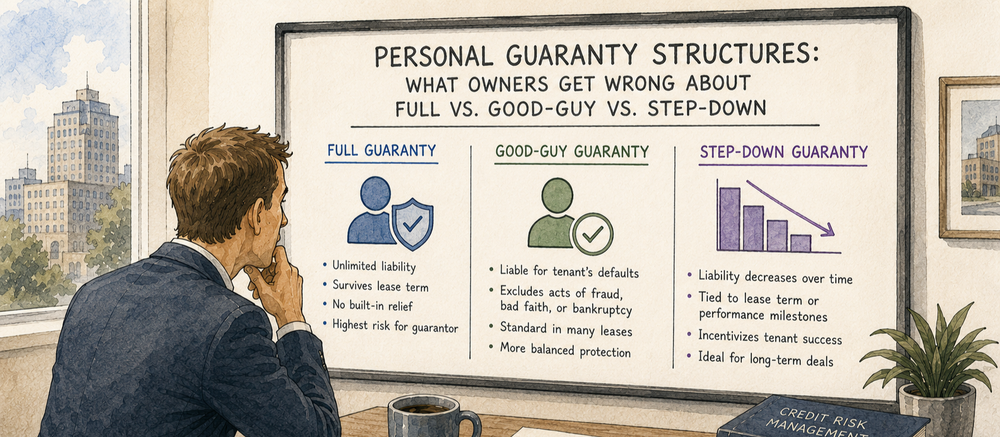
TL;DR: Most commercial property owners ask for a full personal guaranty by default and then quietly accept whatever modification the tenant's attorney pushes back with. That's backwards. The structure of the guaranty matters more than whether you got one, and the wrong structure on the right deal can leave you with less protection than no guaranty at all.
You're leasing a 4,000 sqft suite to a tenant your broker has been working for six months. The LOI is signed. The lease draft goes out. Two weeks later it comes back with a redline on the personal guaranty section — the tenant's attorney has converted your full guaranty into a "good-guy" guaranty.
You forward it to your broker and ask whether to accept. He says it's standard. You sign it.
You just gave away most of what the guaranty was supposed to protect.
This post is for the owners and investors I work with at RG, the operators I see across the San Diego market, and the buyers underwriting deals where the rent roll includes personally-guaranteed leases.
The three structures you're going to encounter are full guaranty, good-guy guaranty, and step-down guaranty. Each one shifts risk in a specific direction, and which one you accept should depend on the deal, not on what your tenant's attorney sent over.
What a personal guaranty actually does
The lease is between the landlord and the entity — usually an LLC the tenant set up specifically to hold the lease. The LLC has whatever assets the tenant put in it, which on a new business is often nothing. If the LLC defaults, you sue the LLC. You get whatever's in the LLC. Often that's zero.
A personal guaranty makes one or more individuals personally liable for the lease obligations. If the LLC defaults, you can pursue the individual's personal assets — bank accounts, equity in their home, investment accounts, future income.
That's the protection. The question is how much of it survives the negotiation.
Structure 1: Full personal guaranty
The individual is personally liable for all lease obligations through the end of the term. If the tenant defaults in year 3 of a 10-year lease, the guarantor is on the hook for years 3-10 of rent, plus operating costs, plus any damages.
Owner perspective: This is what you want, and what you should ask for first. It's also what you will rarely get on a sophisticated tenant.
When to insist on full: Newer business, weak balance sheet, build-out you're funding, second-tier credit, tenant with limited operating history in San Diego. Anywhere you're taking real risk on tenant performance.
The negotiation reality: Tenants with real attorneys will push back hard. You need to know which structure you'll accept as a fallback before you start.
Structure 2: Good-guy guaranty
The individual remains personally liable only until the tenant vacates the premises and surrenders possession to the landlord in broom-clean condition with all rent current.
In plain terms: the guarantor is liable for rent and operating costs that accrue while the tenant is still in the space. The moment they hand back keys with everything paid up, the personal guaranty ends.
Owner perspective: This is a real protection, but only for one specific thing — it disincentivizes the tenant from sitting in the space and not paying rent. It does almost nothing to protect you against the bigger risk of an early vacate.
The trap most owners fall into: If your tenant signs a 10-year lease, defaults in year 3, vacates, hands back the keys, and pays the final month — the personal guaranty is satisfied. You now have a vacant 4,000 sqft suite for the remaining seven years and nobody to chase. The LLC is empty. The individual walks.
When good-guy actually works: When you have a strong leasing market and you're confident you can re-tenant within 60-90 days. The cost of a quick re-let is recoverable. The cost of seven years of vacancy is not.
When good-guy is a trap: When the build-out cost is significant, the submarket is soft, or the tenant improvement allowance you funded won't be recovered through a quick re-let.
Structure 3: Step-down (or burn-off) guaranty
The personal guaranty starts at full liability and reduces over time based on lease performance. A common structure: the guaranty steps down by 20% per year of on-time rent payment, fully burning off after five years of performance.
Owner perspective: This is the structure I see negotiated most often on mid-sized San Diego deals where both sides are sophisticated. It aligns interests cleanly — the tenant earns reduced personal exposure by actually performing, and the landlord gets full protection during the highest-risk period.
What to negotiate inside the step-down:
- The trigger. Does the step-down happen automatically each year, or does it require the tenant to request it in writing? Automatic favors the tenant. Request-required favors you.
- The cure period. If the tenant defaults during the step-down period, does the clock reset to full liability, or does it stay at the current level? Reset to full is what you want.
- The floor. Some step-downs reduce to zero. Some reduce to a minimum that stays in place through the term. A floor of 12 months of rent is a reasonable middle ground.
- The personal financial covenants. A burn-off guaranty is only valuable if the guarantor remains solvent. Some structures include annual financial disclosure to confirm the guarantor's net worth hasn't dropped below the remaining liability.
How to decide which structure fits a deal
The framework I use when I'm reviewing a lease for an owner client:
- What's my actual exposure? Cost to re-tenant + months of vacancy + unrecovered TI + free rent + leasing commissions. Add it up. That's the number the guaranty needs to protect against.
- What's the tenant's substance? If the entity has real assets and operating history, the guaranty is a secondary protection. If the entity is a shell, the guaranty is the only protection.
- What's the submarket doing? In a tight market (Otay Mesa industrial right now) a good-guy may be fine — re-letting is fast. In a soft market (some office submarkets in 2026) you need real long-term protection.
- What's the tenant willing to pay for the structure? If the tenant won't accept a full guaranty, the right move is sometimes to push for a step-down with a tight reset clause AND ask for 2-3 months of additional security deposit. The cost of one matters to them; the cost of the other shows up on their balance sheet differently.
The mistake I see most often
Owners and their brokers focus on whether they got a personal guaranty, not on what structure it is. A weak structure on the right tenant is fine. A weak structure on the wrong tenant is a problem you'll discover when it's too late to renegotiate.
The guaranty is a tool. Pick the right one for the deal.
Have a question about a lease you're negotiating or a property you're underwriting? I do free 30-minute consultations for San Diego owners and investors.
Anthony D. Bruno is a Commercial Real Estate Advisor and Property Manager at RG Investment Real Estate Services in San Diego. CA DRE #01737517.