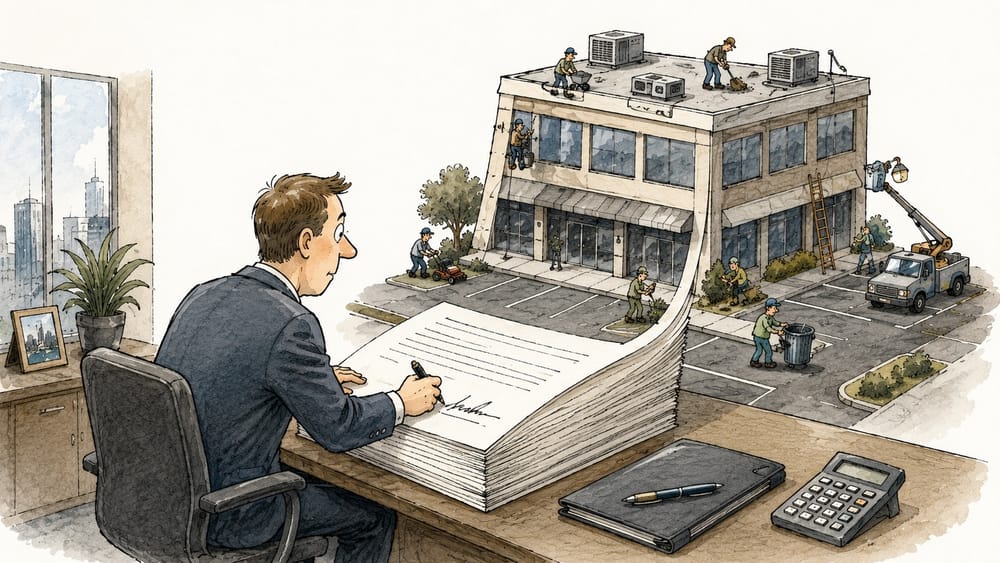
You negotiated base rent down to $1.50 per square foot. You modeled your 3% annual escalations. You know what the space costs. Except you don't — not yet. The number that will surprise you in Year 5 isn't the rent. It's everything on top of it.
NNN leases are the dominant structure in San Diego commercial real estate for industrial, retail, and many office deals. If you're signing one for the first time — or if you signed one five years ago and you're about to renew — this is the mechanics conversation most tenants never get. The brokers on the landlord's side of the table understand every line of it. You should too.
What "Triple-Net" Actually Means
A NNN lease (also called a triple-net lease) is a structure where the tenant pays base rent plus three additional expense categories: (1) property taxes, (2) building insurance, and (3) CAM — common area maintenance, which covers the operating costs of shared and exterior building areas. These three items are the "three nets." They stack on top of your base rent every month.
In a gross lease — more common in some office deals — the landlord wraps those costs into a single rent number and absorbs the fluctuations. In a NNN lease, the landlord passes the risk of cost increases directly to you. That risk transfer is the whole game, and understanding it before you sign changes what you negotiate.
CAM: The Line Item That Compounds While You're Not Watching
Property taxes and insurance are relatively predictable. CAM is not. CAM (common area maintenance) covers landscaping, parking lot maintenance, exterior lighting, security, common area utilities, and — critically — a property management fee that landlords charge for administering the property. That management fee typically runs 10–15% of total CAM costs, and most first-time NNN tenants don't realize it's in there at all.
Here's how CAM billing actually works. At the start of each year, your landlord estimates what CAM will cost and bills you a monthly amount. At the end of the year, they calculate what CAM actually cost, compare it to what you paid, and send you a reconciliation statement — a true-up for the difference. If actual costs ran higher than estimated, you owe the balance. Across deals we see in San Diego, that true-up regularly runs 8–15% above the original estimate. In a year with a major repair, it can run much higher.
The Year-5 Math: A Worked Example
Let's run the numbers on a realistic San Diego industrial deal. These figures reflect what we see across market deals — they're illustrative, not pulled from a single dataset, but they're grounded in current market reality.
Year 1 Starting Point
| Cost Component | Year 1 Rate | Monthly Cost (5,000 sqft) |
|---|---|---|
| Base Rent | $1.50/sqft | $7,500 |
| CAM (estimated) | $0.35/sqft | $1,750 |
| Total Year 1 Occupancy Cost | $1.85/sqft | $9,250/month |
Year 5: The Two Scenarios
Scenario A assumes CAM grows at 5% compounded annually — a reasonable, unspectacular rate. No major repairs. No big surprises.
Scenario B is the year the landlord recoats the roof and resurfaces part of the parking lot. One large-scope repair. Entirely within what many standard NNN leases allow to be passed through to tenants.
| Cost Component | Year 1 | Year 5 (Scenario A) | Year 5 (Scenario B) |
|---|---|---|---|
| Base Rent | $1.50/sqft | $1.74/sqft (3% annual) | $1.74/sqft |
| CAM | $0.35/sqft | $0.43/sqft (+22%) | $0.55–$0.65/sqft (+57–86%) |
| Total Occupancy Cost | $1.85/sqft | $2.17/sqft | $2.29–$2.39/sqft |
| Monthly (5,000 sqft) | $9,250 | $10,850 | $11,450–$11,950 |
Scenario A puts you $1,600/month higher than Year 1. Scenario B puts you $2,200–$2,700/month higher. Neither number is your base rent escalation — that's just base rent, which most tenants already modeled. These are the costs most tenants didn't see coming.
The Capital Expense Gray Zone
This is the most dangerous part of a standard NNN lease, and the part landlord attorneys write most carefully.
Many NNN leases include language that allows landlords to pass through the cost of capital improvements — repairs and replacements to major building systems — to tenants. HVAC (heating, ventilation, and air conditioning) replacement. Roof repairs or recoating. Parking lot resurfacing. These are not routine maintenance line items. A single HVAC replacement on a mid-size industrial building can run $30,000–$80,000. A roof recoating can run similar numbers. When those costs are allocated across your square footage and billed through CAM, your monthly charges spike — often with little warning.
The lease language that controls this is the capital expense exclusions rider (or CAM exclusions addendum). This is an addendum — an additional written section added to the lease — where you negotiate which costs the landlord can and cannot pass through to you. In most deals we see, tenants negotiate base rent hard and then sign whatever CAM language the landlord's attorney drafted. That is exactly backwards. The CAM exclusions rider is the single most under-negotiated document in a standard NNN lease.
Four Lease Levers Most Tenants Don't Know They Can Pull
1. The CAM Cap on Controllable Expenses
A CAM cap limits how much your controllable CAM expenses — maintenance, management fees, landscaping, and similar items the landlord has discretion over — can increase year over year. A 5% annual cap on controllable expenses is a standard, achievable negotiating position. Property taxes and insurance are typically excluded from the cap because the landlord genuinely cannot control them. But management fees, landscaping contracts, and routine maintenance? Those are negotiable, and capping them protects you from administrative cost creep.
2. The Per-Item Capital Expense Threshold
Negotiate a dollar threshold above which capital expenditures cannot be passed through to you as CAM — or must be amortized (spread out over time, like monthly installments on a loan) rather than billed as a lump charge. A common negotiated position: any single capital item above $10,000 either gets excluded from CAM entirely, or gets amortized over its useful life with only the annual portion billed to you. This directly addresses the roof-and-HVAC surprise scenario.
3. The Property Management Fee Cap
Landlords almost universally charge a property management fee as part of CAM — typically 10–15% of total CAM costs. On a $0.35/sqft CAM pool, that's $0.035–$0.052/sqft just in management overhead. That fee is negotiable. Across deals, 5–8% is achievable with straightforward pushback. It sounds like a small number per square foot, but over a 5-year lease on 5,000 sqft, the difference between a 15% and a 6% management fee is meaningful.
4. The Gross-Up Provision
In a multi-tenant building, if overall occupancy drops — say, a major tenant vacates and the building sits at 75% occupied — CAM costs don't drop proportionally. Fixed costs like exterior lighting and landscaping don't shrink because one suite is empty. A gross-up provision allows the landlord to calculate and bill CAM as if the building were at a minimum occupancy threshold (typically 95%), rather than actual occupancy. Counterintuitively, this provision can actually protect tenants in a low-occupancy building — it prevents your CAM from spiking simply because your building lost tenants, and it standardizes your exposure. If a landlord tries to remove this provision, push back.
Audit Rights: A Tool Almost No One Uses
Virtually every commercial lease includes audit rights — the tenant's contractual right to inspect the landlord's CAM expense records and verify that charges are accurate. Across deals, audit rights exist in the vast majority of NNN leases. Fewer than 5% of tenants ever exercise them.
This is a straightforward leverage point. If you receive a year-end CAM reconciliation showing a jump of 10% or more over the prior year, you have the right to ask for the documentation behind it. You don't need to hire a forensic accountant. A basic review of invoices and allocation methodologies catches the most common issues: management fees charged above the contracted rate, expenses allocated across fewer tenants than occupy the building, or capital items billed as routine maintenance. If you signed a lease with audit rights and you've never used them, that protection is sitting idle.
The Renewal Conversation Most Tenants Lose Before It Starts
Many NNN leases include an option to renew — the tenant's right, but not obligation, to extend the lease for an additional term at the end of the initial period. Most 5-year leases include a renewal option at "fair market rent," meaning the base rent resets to wherever the market is at Year 5. That's the part tenants know to expect.
What tenants miss: the CAM terms often roll over unchanged unless you affirmatively renegotiate them. You can be handed a renewal term with the same uncapped CAM language, the same management fee structure, and the same capital expense exposure you signed five years ago — only now you have five years of compounded cost growth baked into the starting baseline. At renewal, every CAM protection you negotiated (or didn't negotiate) in the original lease is back on the table. Treat the renewal negotiation as a full lease negotiation, not a rent conversation.
Practical Takeaway
Before you sign any NNN lease, get the CAM exclusions rider in front of your attorney and push on four specific points: a cap on controllable CAM expenses (5% annual is a reasonable ask), a per-item threshold for capital expenditures above which costs are excluded or amortized rather than passed through in full, a property management fee cap in the 5–8% range, and a gross-up provision if you're in a multi-tenant building. After you sign, track your annual CAM reconciliations. If any year shows a jump of 10% or more, exercise your audit rights — they're in your lease. And when renewal comes up, don't accept rollover CAM terms. Renegotiate the whole structure. The base rent number is what both sides argue over at the table. The CAM language is where the actual five-year cost gets written.