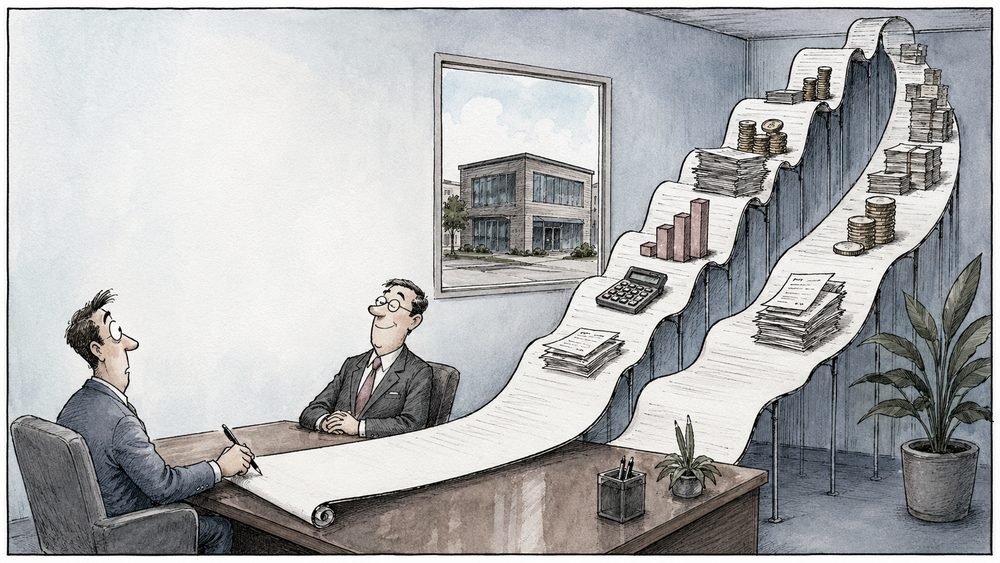
NNN (triple-net) leases pass three categories of building expense from landlord to tenant on top of base rent: property taxes, building insurance, and CAM — common area maintenance. CAM is the catch-all bucket: landscaping, parking lot upkeep, exterior lighting, security, common-area utilities, property management fees, and any other operating expense the lease defines as "common."
The reason CAM matters more than the other two is that taxes and insurance are externally set — the county and the insurance carrier produce a bill, the landlord passes it through, end of story. CAM is internal. The landlord controls what gets included, what gets billed, what gets "trued up" at year-end, and what gets categorized as operating versus capital expense. That control is where the overcharges live.
Here's the mechanism in plain terms. At the start of every year, the landlord estimates total CAM for the building based on last year's actuals plus expected increases. They divide that estimate by the building's total square footage and bill each tenant monthly at that per-square-foot rate. At year-end, they total what was actually spent, compare to what was collected, and either send a reconciliation invoice (you owe more) or a credit (rare).
The reconciliation invoice is where tenants get hit. And it's also where the audit happens — or doesn't.
The four overcharges that show up most often
1. Capital expenses misclassified as operating expenses
This is the single most expensive line item to miss. Most leases distinguish between operating expenses (passed through to tenants) and capital expenses (the landlord's responsibility). A new HVAC system, a roof replacement, a parking lot resurface — these are capital. A monthly HVAC service visit, a roof patch, a pothole repair — these are operating.
The gray area is where landlords push. A "major HVAC repair" that's really a partial replacement. A "roof maintenance program" that includes a full recoating. A "parking lot maintenance" line that includes resealing every five years at $40,000 per occurrence.
What we see across deals: most leases give the landlord some latitude to amortize capital items as operating expense over their useful life. That's reasonable. What's not reasonable is when the same capital item shows up as both an amortized line AND a separate operating expense the next year. Audit catches this.
2. Property management fees stacking on admin fees
Standard landlord practice: charge a property management fee (typically 3–5% of gross collections) for managing the building. Reasonable.
Less reasonable: charge a separate "administrative fee" (often 10–15% of CAM) for the work of preparing the CAM reconciliation. Now reasonable: charge BOTH on top of each other.
This is one of the most common overcharges in CRE. The lease language often allows it because tenants don't push back at signing. The negotiation move at signing: cap total management + admin fees combined at 5–8% of CAM, not stacking percentages.
3. Gross-up math that ignores actual occupancy
Gross-up provisions exist because building expenses don't scale linearly with occupancy. A half-full building still needs the parking lot lit, the landscape maintained, the security on. If a landlord charged CAM only on actual occupancy, they'd absorb the fixed costs of empty space.
The standard fix is to "gross up" variable expenses as if the building were 95% occupied. Then tenants pay their pro-rata share of that grossed-up number.
The math gets gamed two ways:
- Gross-up applied to fixed expenses too (not just variable). Fixed expenses don't change with occupancy — there's nothing to gross up.
- Gross-up applied with no documentation of actual occupancy. The tenant has to take the landlord's word that the building was 65% occupied and grossed up to 95%.
What an audit produces: actual occupancy data and the actual variable vs. fixed expense split, applied correctly.
4. Pass-throughs that violate the lease's own exclusion list
Most leases include a list of expenses explicitly excluded from CAM. Standard exclusions: leasing commissions, marketing costs for vacant space, landlord's general overhead, executive compensation, capital improvements beyond a defined threshold, expenses recoverable from insurance, expenses related to tenant disputes.
What we see across deals: tenants negotiate a robust exclusions list at signing, then never check whether the landlord honored it in practice. Marketing costs for vacant suites show up as "tenant retention" line items. Executive compensation gets buried in "administrative overhead."
The audit comparison is simple: pull the lease's exclusion list, pull the reconciliation backup, line-item check. The dollars add up faster than most tenants expect.
What an audit actually looks like
Most CRE leases give tenants the right to audit CAM reconciliations within a defined window — usually 60 to 180 days from receipt of the reconciliation invoice. The audit right typically requires written notice, may impose cost-sharing rules (tenant pays unless overcharges exceed 3–5%, then landlord pays), and requires the tenant to use an independent third party (often a CPA firm specializing in lease audits).
The audit process is structured:
| Step | What happens |
|---|---|
| 1. Notice | Written request to landlord per lease terms — usually within 60–180 days of receiving reconciliation |
| 2. Document request | Request supporting docs: invoices, contracts, GL entries, occupancy data, gross-up calculations |
| 3. Line-item review | Auditor compares billed expenses against lease exclusions, capital/operating definitions, and supporting documentation |
| 4. Findings letter | Auditor delivers findings: overcharges identified, dollar amounts, lease provisions cited |
| 5. Resolution | Negotiation with landlord — most resolve as credit against next year's CAM or refund check |
Audit cost typically runs $3,000–$10,000 depending on building complexity and number of years audited. For a tenant occupying 5,000 sqft at $0.45/sqft CAM, that's $2,250/year — meaning a 15% overcharge ($340) pays back in 10–30 years. Not worth it.
For a tenant occupying 30,000 sqft at $0.45/sqft, the same 15% overcharge is $2,025/year — payback in 1.5 to 5 years on the audit cost alone. Worth it.
For larger spaces and longer lease terms, audit math is unambiguous. Most tenants still don't do it.
What to negotiate before you sign (or at renewal)
The audit lives in the lease language. If the lease doesn't give you favorable audit terms, you can't add them later. Standard items to negotiate:
- Audit window: minimum 180 days from receipt of reconciliation, not 60. 60 days is too short to do a real audit.
- Cost-sharing trigger: if audit finds overcharges greater than 3% (not 5% or 7%), landlord pays audit cost.
- Documentation rights: explicit right to receive invoices, contracts, GL entries, and gross-up calculations. Some leases let the landlord refuse "confidential" documents — push back on that.
- Auditor selection: tenant chooses the auditor. Some leases require a "mutually agreed" auditor, which becomes a delay tactic.
- Look-back period: right to audit prior years' reconciliations, not just the current one. Three-year look-back is standard.
- Exclusions list: robust, specific, and updated. Generic exclusion language gets argued.
- Cap on controllable expenses: 5% annual cap on year-over-year increase of controllable CAM expenses. Non-controllable items (taxes, insurance, utilities) are excluded from the cap.
The practical takeaway
If you're a CRE tenant: get out your last three CAM reconciliation invoices and your lease. Read the audit rights section. Note the deadline. If you're inside the window and your space is over 10,000 sqft, the math on a professional audit usually works.
If you're about to sign a new lease or renew an existing one: the audit rights you negotiate now determine what you can do five years from now when the reconciliation hits. Negotiate the audit window, the cost-sharing trigger, the documentation rights, and the exclusions list. Tenants who treat CAM as boilerplate during negotiation pay for it every year afterward.
If you're a landlord reading this: most of these overcharges happen because property managers are running the same templates building-to-building without auditing themselves. The tenants who catch the overcharges aren't troublemakers — they're sophisticated. The cost of an honest reconciliation is much smaller than the cost of fighting an audit that finds problems.
Lease coming up for renewal in the next 12 months? Book a free 30-min consultation →